Tips from a care partner’s journey

When I began my caregiving journey, I was, to put it mildly, ill-prepared. I saw only loss, not the person, heard only confusion, not the thoughts. I looked at the clock, always hearing Mom’s voice, “Walk Away.”

When Mom began to paint everything changed. Instead of loss and sadness, we were sharing joy. That was the key. I was able to understand her as a whole person enjoying life. I began to learn, and change, from a very reluctant caregiver to Mom’s very happy partner.

For anyone at the beginning of their caregiver journey, here are some tips from Mom and me.

Smile – a lot.

Don’t Walk Away.  It’s tempting to tell yourself that it doesn’t matter.  That she/he won’t remember it anyway.  

It matters. They may forget everything you said and did in five minutes but the happiness you shared lasts—for them and for you. 

This isn’t about you, how you would feel if you had dementia.  But you don’t. They do and, with your support, they can thrive and live with happiness and purpose.

Remember that you are partners – building the best possible life for both of you. And the cool thing is that your life together can be an exciting process of enrichment and mutual discovery. 

Let go of the person s/he used to be and embrace the person who is with you in the moment. A whole person with a life to live and gifts to give—living with dementia not suffering from.

Let go of the questions designed to bring them back, like “Do you remember?” or “Don’t you remember?”  They only frustrate her and disappoint you. And they will absorb your sadness. Remembering isn’t the goal.  The goal is to live an active life connected to the world around them. 

Enjoy the moment. Unsure about how? Try this first step. Pick something you both enjoy doing. It can be simple: take a walk, look at the view, sing a song, play a game (with Mom it was Scrabble), anything. Just relax and enjoy, together. 

Take them seriously. Ask questions and listen. More often than not they are telling you something.

Remember that we share basic human needs that never leave us – all of us. 

The need for friendship

The need for laughter

The need for purpose

The need to love and be loved.

I hope I can age like Mom, living a life abundant with love, purpose, and friends, fascinated by the world, curious about the future, and filled with laughter—focusing on the positive, accepting the inevitable, and enjoying the ride.

Love you, Mom.

Guest Post: A hopeful Alzheimer’s perspective by Thomas J. Grabowski, MD

“I learned to let go of the woman I felt she used to be, embracing instead the wonderful woman who was with me in the moment; not suffering from dementia, but living with it. “

Don’t Walk Away is a remarkable and inspiring story of a daughter’s journey as a caregiver, and the insights she gained from embracing the strengths that were revealed in her mother living with Alzheimer’s disease.

The story is remarkable, first of all, for illustrating that dementia does not only destroy, but also spares things.  Jean, the mother, is witty, purpose-driven, curious, modest, and she surprises Marilyn, the daughter, with a vibrant creative impulse, moment by moment.  These retained strengths are recognized and brought out by Marilyn, who shares so much common ground with her, and thus helps her interpret the world, acting as a sort of scaffolding  on which Jean’s moments rest.  I can’t think of a case in my experience as a memory clinician where this principle is better expressed.  In this sense the story is a master class in caregiving.  I’m making a mental note that it should be required reading in the Memory and Brain Wellness Center

The story also fascinates for its insight into a surprising discovery of caregiving in dementia.  In the usual order of things, a mother treasures and wonders about her infant, who is in a body but not yet able to fully communicate its inner life, though, later, it is clear that a unique personality and identity were there all along.  In our story, the roles reverse, and it is the daughter who wonders about and longs to know the mother, whose processes of expressing her internal experiences have become impaired and discontinuous.  Marilyn strains to tune in to her mother’s experience “in the moment” and is rewarded with the evidence that her mother “is still here,” and indeed “distilled to her essence.”  The story and dialogue are pithy and specific.  We come to know their voices and to share Marilyn’s epiphanies.

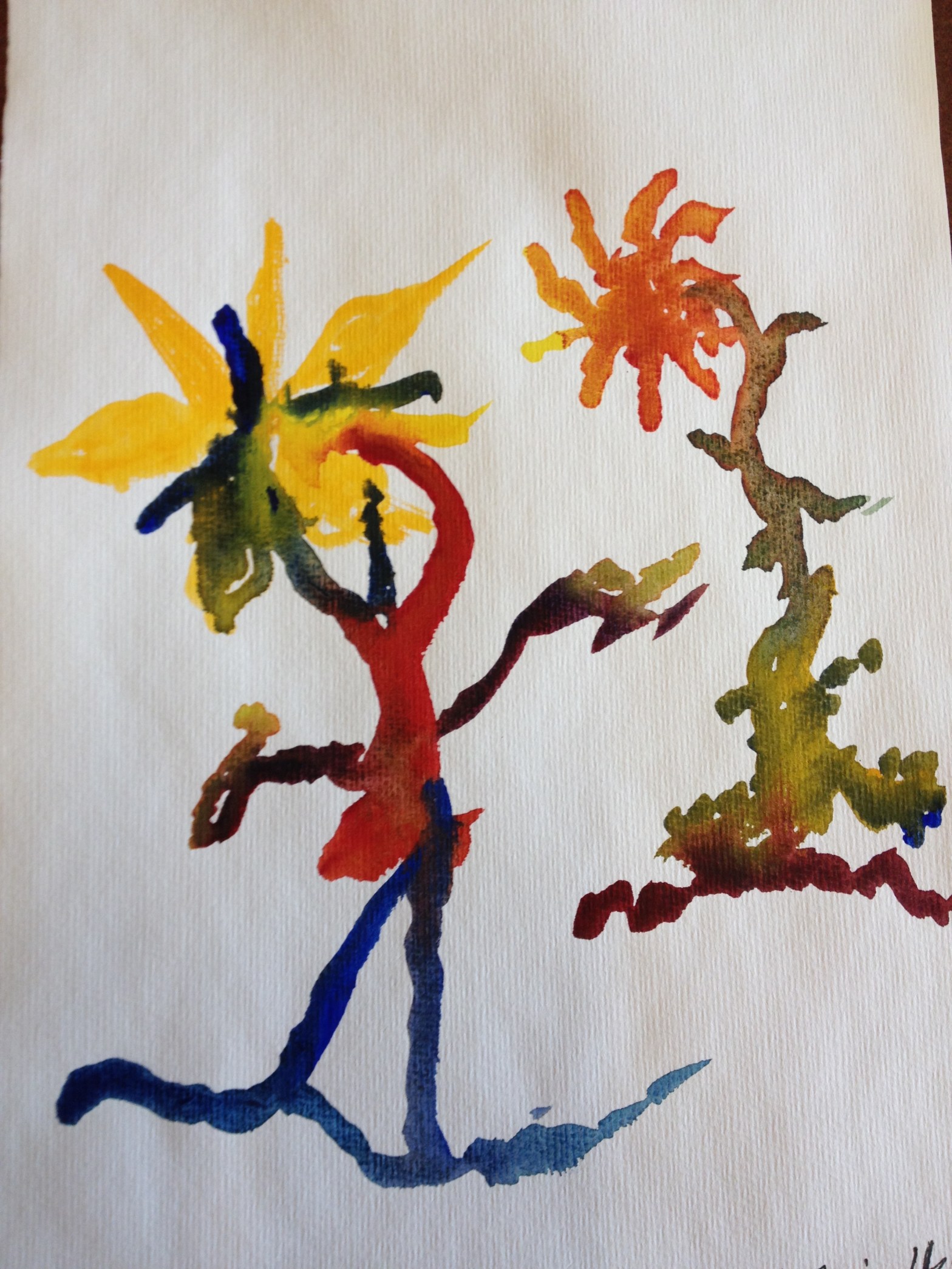
And finally, there is the delightful device of juxtaposition of the narrative and quoted points of dialogue with Jean’s watercolor paintings.  We see more deeply through the playful art what we glimpse in the verbal play and Scrabble score.  In effect, Marilyn has curated her mother for us.  She provides a scaffolding for us, too, to understand her mother’s behavior in the moment.  Would that everyone living with memory loss had such a curator.

– Thomas J. Grabowski, MD

Professor, Department of Radiology/Joint Professor, Department of Neurology, UW Medicine /Tim B. Engle Endowed Professorship for Brain Health Innovations

Sharing Joy

Several years ago I met a man who told me about his wife,  who was living in a nursing home and living with dementia. He was so very sad.  

“When I visit her, she knows who I am.  She kisses me and tells me she loves me.  When I look in her eyes there is nothing there and I leave in tears.”

I wondered.  Why could he not see what I most likely would have?  A woman with something to say.

If your relationship with your loved one is defined by sadness and loss, that is all you can see, all you can hear, all you can feel.  But if you can share a  moment of happiness, it changes.  You can see and enjoy the person who is still there.

It can be so simple – like Mom’s first painting, or looking at the view, a sunset, taking a walk together.  You can listen to the music she once loved (and probably still does)  and see her face light up with delight.  Or sing.  With Mom, I would begin a song and she would join.  If she didn’t know the words, we would sing the melody together.

At each moment, we were sharing joy and each other.  I hope I can age like Mom, living a life abundant with love, purpose, and friends, fascinated by the world, curious about the future, and filled with laughter—focusing on the positive, accepting the inevitable and enjoying the ride.

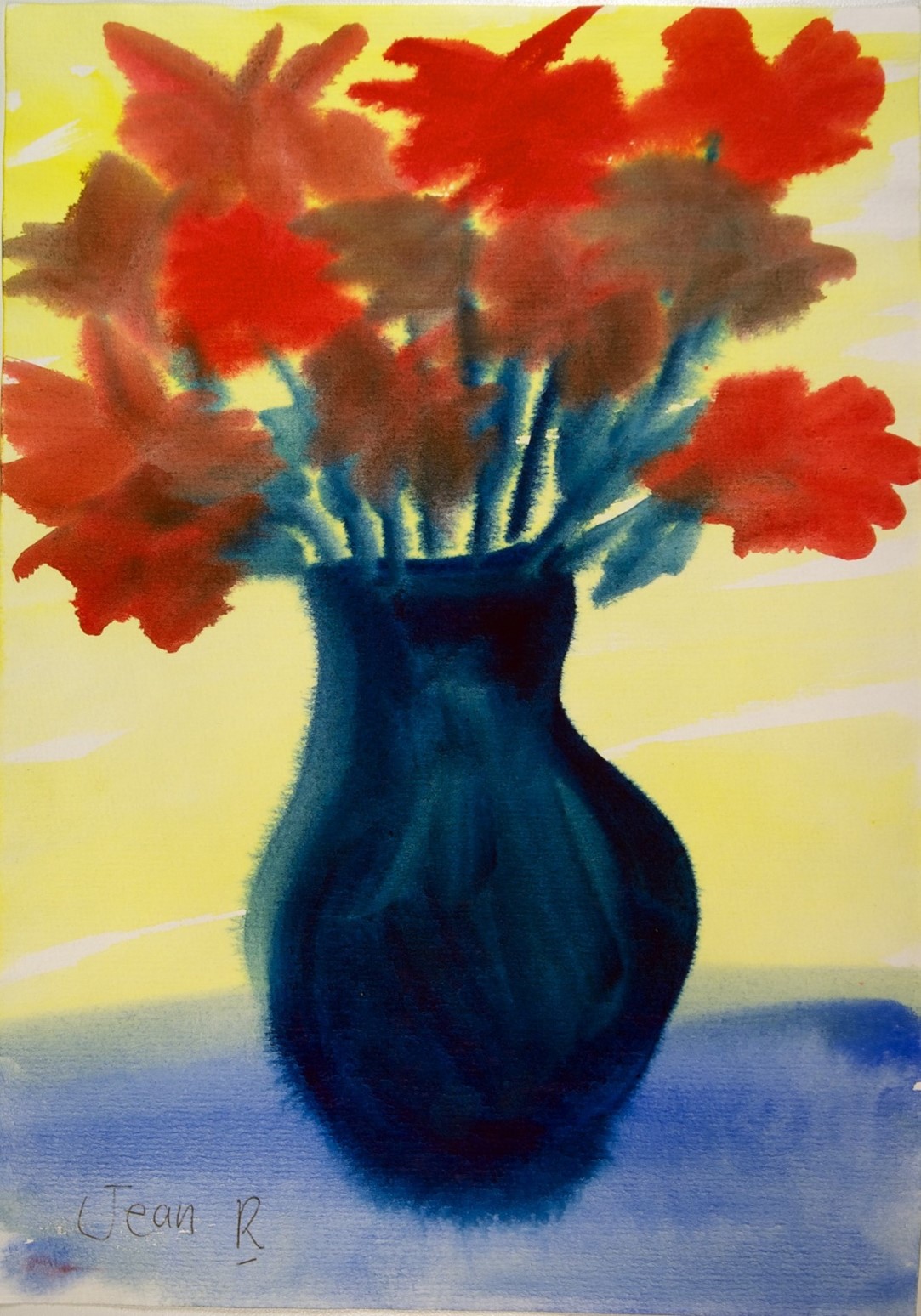
Mom’s first painting

I cannot overstate the impact of Mom’s first painting.  It transformed our relationship and my life.

At the first class I was as skeptical as Mom.  She thought it was a ridiculous thing to do, suitable only for children.  I didn’t expect much either – just that she would be momentarily distracted from the boredom of her life without Dad.  

I was amazed. Her painting was lovely.  

Everything changed.

Each week, I saw a new painting, a new window into thoughts and emotions she wasn’t able or willing to express verbally.  Each week I learned to let go of the woman I felt she used to be —  each week more willing to embrace the woman who was with me in the moment — witty, happy, friendly, curious.  A woman for whom everything was “just delightful.”  Increasingly my life was becoming more delightful as well.

I did have to learn a few more things.  I made sure that she attended each class. She still thought that painting was a stupid thing to do.  

“Why am I here?,” she would ask.

“Because you’re going to paint.”

“I don’t do this,” she would look at me mystified.

I also learned to bring her paintings home.  Otherwise, she would throw them away.  I have saved every one.

Thanks, Mom.